The Guardian: ‘If there’s a rule, he tries to break it’: the explosively colourful works of Sam Gilliam
Sam Gilliam’s artistic life was bookended by success against the odds. In 1972, he became the first Black artist to represent the US at the world’s most prestigious art festival, the Venice Biennale. He had overcome poverty and prejudice in the south to study art at one of the first desegregated universities, and, after settling in Washington, was hailed as a radical innovator within the group of abstract painters dubbed the Color School.
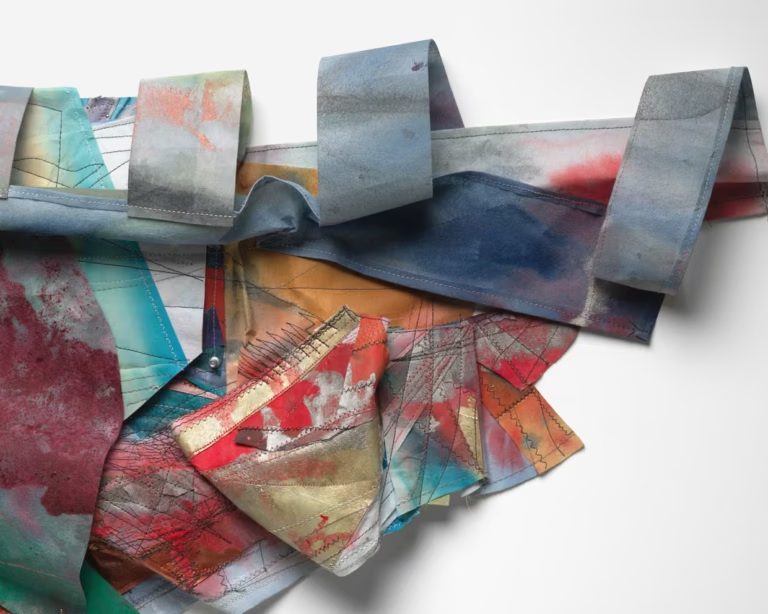
Pushing his medium in new sculptural directions, he broke convention by taking his canvases off their wooden stretchers. His best-known colour-drenched works have an improvisatory quality, never installed the same way twice, whether they’re draped on the wall or hung tent-like from the ceiling.
When the art world turned away from abstraction in the following decades, however, he was all but forgotten. He was approaching 80 in 2012 when the young art star Rashid Johnson championed his work, curating an exhibition that led to a fresh slate of big international shows and museum recognition. Yet as Gilliam said in an interview two years before his death in 2022, in art, “Sometimes you win, sometimes you lose. But I’ve never lost entirely. We just keep on keeping on.”
Sewing Fields, a new exhibition featuring unseen work from Gilliam’s residency at the Ballinglen Art Foundation on the west coast of Ireland in 1993, reveals how he never stopped making and innovating.
“He was so prolific,” says the show’s co-curator, Mary Cremin. “There’s still a huge amount of his work that’s never been shown.” One of the biggest surprises is that he worked in Ireland at all. The isolated rural location with its sea cliffs and rolling hills must have been a major change for an artist who spent his life in cosmopolitan Washington’s creative community.
He wasn’t afraid of mixing things up, though. Prohibited from flying across the Atlantic with petrol-based paints, he was compelled to paint, print and dye materials in his Washington studio in advance, and pursue new processes in Ireland. It resulted in a fresh approach with cut-up collaged fragments of paintings including screen-printed cloth and paper and material thick with paint. “Needs must is the mother of invention,” says the curator.
It was the experience of being captivated by laundry billowing on a line that first led Gilliam to set the canvas free from wooden stretchers to create his characteristic draped works. His approach to painting was expansive, underlining art’s connection to lowly cloth while nodding to histories of Black female labour. In Ireland, he worked with a seamstress to stitch his layered compositions of collaged painted fabrics with distinct zigzagging lines of thread. “He supposedly had six sewing machines in his Ballinglen studio,” says Cremin. She points out that Ireland’s light and unpredictable weather fed into Gilliam’s explosive use of colour, too. “The sky changes, the seasons change in a single day,” says Cremin. “In these works, the tone changes all the time.”
One reason given for Gilliam’s art-world wilderness years is that, during the rise of identity politics in the 1980s, his work didn’t foreground Black experience. Today, it’s his commitment to constant experimentation within his medium that the curator sees as crucial to his legacy for younger artists. Says Cremin: “If there’s a rule, he tries to break it.”
Read more.